What the rules said no to: crypto, updated
Before a trade idea is taken, a set of rules can say no. The scorecard does not forget those ideas: it simulates each one as if it had been taken.
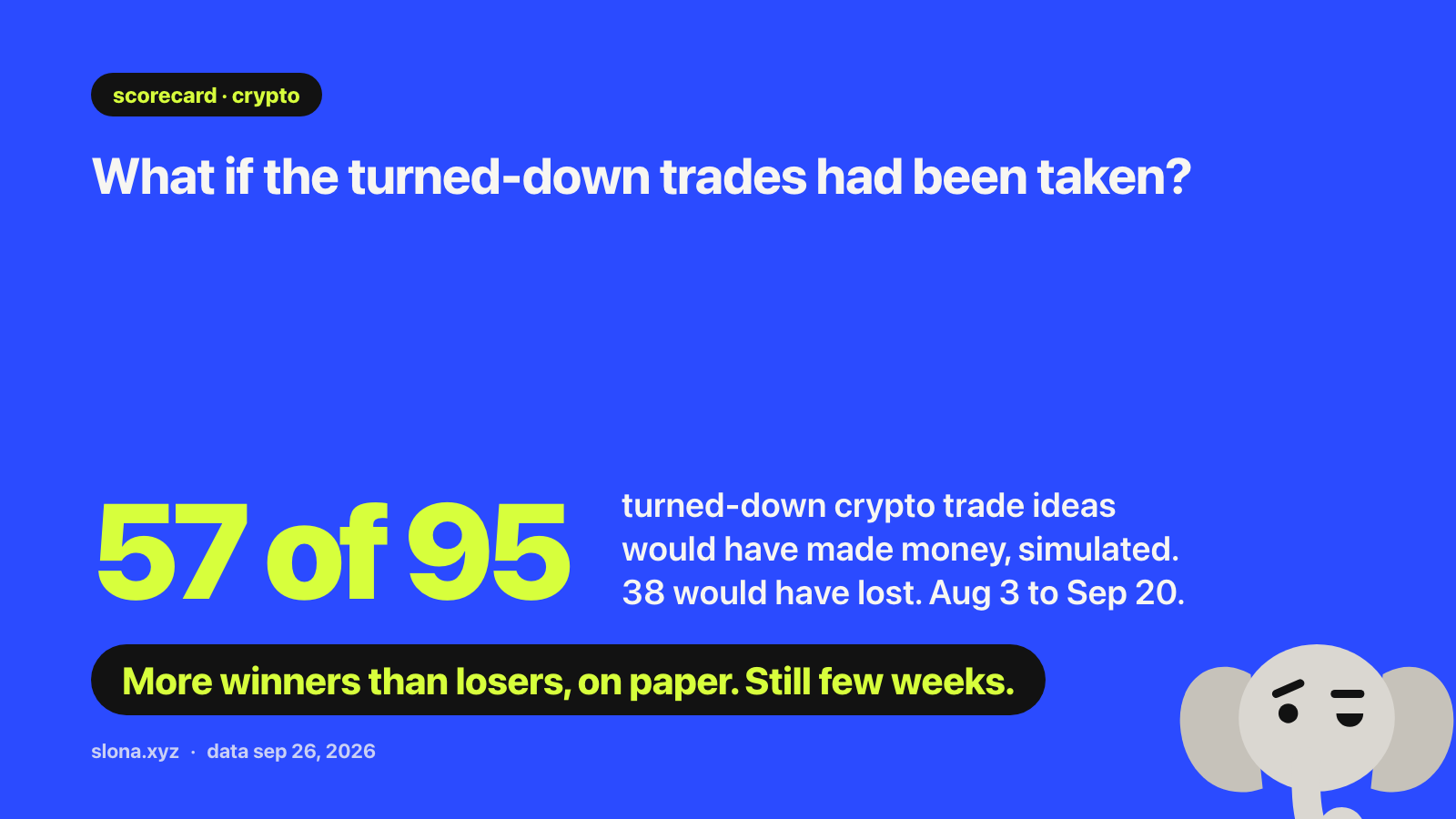
Crypto, Aug 3 to Sep 20, 7 finished weeks: the rules said no to 158 trade ideas. 95 could be simulated to the end: 57 would have made money and 38 would have lost. Taken together, those 95 would have made money. The rest never got going or could not be simulated.
The first count, weeks ago, was about even. With more finished weeks, the turned-down ideas lean the other way: more winners than losers, and a gain overall, on paper.
These are simulated trades, entered and exited by fixed rules, not by a person. A count like this moves with every finished week, and 7 weeks are still few.
When the ideas a filter blocks do well on paper, is the filter wrong, or is the sample still too small?
Personal technical notes: market scenarios with probabilities and levels, generated semi-automatically. This is NOT financial advice or a recommendation to trade. Data may be incomplete, delayed, or incorrect; decisions and risk are entirely the reader's.